


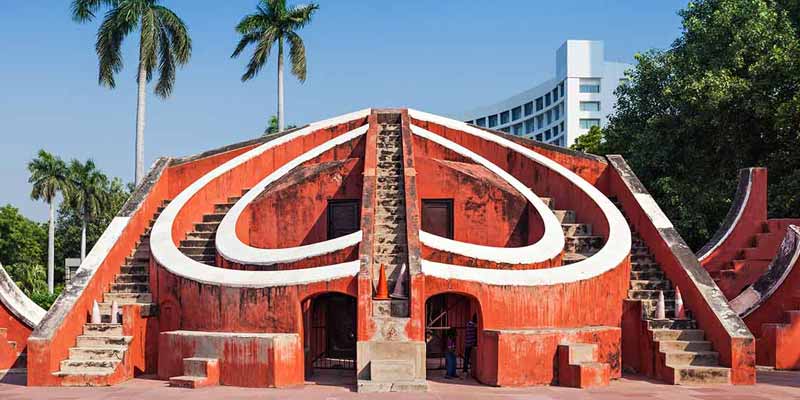
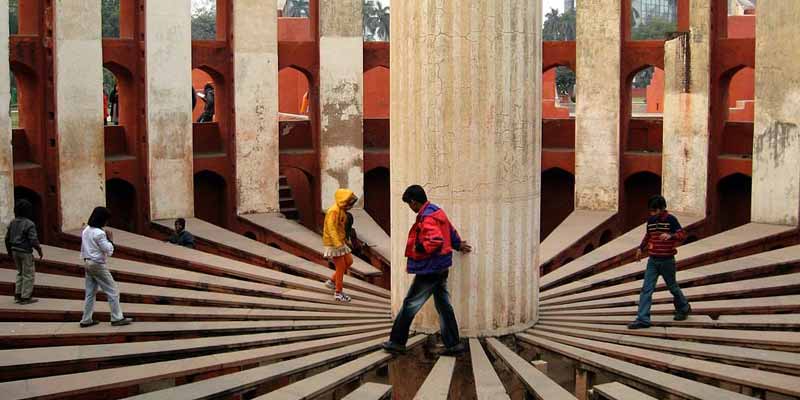
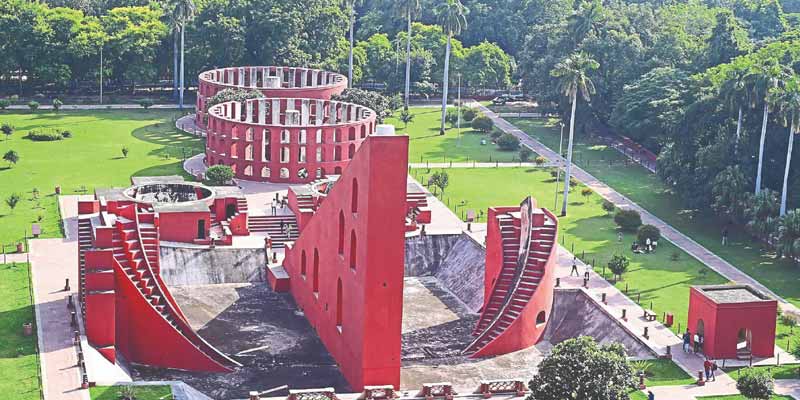
Jantar Mantar Delhi is a rare place where science looks like architecture. Step inside and you don’t see telescopes or glass domes — you see giant stone instruments: triangles, arcs, circular wells, all built to measure time, shadows, and the movement of the sun and stars with the naked eye. The city noise fades as you walk past the entrance; inside, the air feels open and sunlit, with sharp angles of red-plastered masonry throwing crisp shadows on the ground.
This observatory was created in the early 1700s by Maharaja Sawai Jai Singh II, who built similar Jantar Mantars across North India. Delhi’s is compact compared to Jaipur’s, but it carries a special vibe: a calm scientific courtyard right in the capital’s most modern, traffic-heavy belt. If you enjoy heritage with meaning, Jantar Mantar is a short but memorable stop.
History of Jantar Mantar
Maharaja Sawai Raja Jai Singh was a renowned scholar in the court of Emperor Muhammad Shah. He was assigned the task of confirming and rectifying currently available data about the movement and transitions of the celestial bodies. This task made Maharaja Sawai Raja Jai Singh direct his focus towards refining ancient Islamic Zij tables. By doing so, the astronomers of that era could be in a position to trace the exact hour for the said day.
In fact, his aim was designing a precise calendar for giving rise to astronomical predictions for benefiting mankind. As an undeniable part of his mission, he set out on a task to lay the foundational stone for Jantar Mantar in the year 1724. Likewise, the astronomical observatory first came to built in the heart of the capital city of India – Delhi. After that, four more observatories were raised each in Ujjain, Varanasi, Jaipur, Ujjain, and Mathura.
Over time, the astronomical observatory structure at Delhi underwent deterioration until 1867. This called for the direct attention of the administrative measures to restructure it to its former glorious foundation. With a proper administration and maintenance, this observatory at Delhi today stands as a popular tourist attraction.
The Architecture of Jantar Mantar
The credit to this architectural brilliance is attributed to Maharaja Sawai Jai Singh who was working on a project assigned by his Mughal Emperor – Muhammad Shah. With a view to re-assessing the current astronomical observations and charts, Maharaja Sawai Jai Singh laid the foundation for these sundials in different parts of the country. The first of all these astronomical observatories was the one constructed in Delhi. The four main instruments present within the premises of Delhi’s Jantar Mantar are as follows –
1. Misra Yantra –This instrument was constructed to translate into a mix which is a combination of five different devices. The basic idea behind blending these five instruments to work in tandem was to assess both the shortest and longest day of the year. Besides, it was even used to track the noontime across different cities of the world. Interestingly, the instrument worked in their favour to accurately predict the noon time in major cities across the globe.
2. Samrat Yantra – Samrat Yantra is alternatively known as a principal instrument. It measures 70 feet high and has a thickness of 10 feet. This resembles an equal hour sundial which has the shape of a great triangle. It is acknowledged to hypotenuse runs 128 feet in its overall length. Lying parallel along the earth’s axis, the instrument points in the direction of the North Pole. It has got indicators on either side of it where every single unit represent hours, minutes, and seconds respectively. It was uniquely constructed to predict the declining phase of the celestial bodies more accurately in comparison to other sundials of that era.
3. Jaiprakash Yantra – Jaiprakash Yantra is comprised all of the hemispherical structures which are hollow in their overall appearance. They have a concave appearance. They are equidistantly marked and accompanied by attached crosswires stretched in such a way to meet their rims.
A crosswire present at the level of the rim has a metal plate with a circular opening towards the centre of the Yantra. This is the most important plate to serve as a device for recording all the night observations. It also works towards casting the identifiable shadow on the interior portion of the yantra to record solar observations.
4. Rama Yantra – Rama Yantra are those instruments which were devised to accurately measure the altitudes of the planet based on their celestial position.
Best Time To Visit Jantar Mantar
Winter season (between November to March) is the best to plan your visit to the Jantar Mantar Delhi. Throughout the period, the climate remains consistently pleasant. For your ease of movement, twin your light wear clothes coupled with a pair of best sunglasses and a wide-brimmed hat.
How to Reach Jantar Mantar Delhi
Jantar Mantar, Delhi is centrally located near Connaught Place and is easy to reach by multiple transport options:
By Metro: The nearest metro station is Rajiv Chowk (Yellow Line & Blue Line). From there, Jantar Mantar is about a 5–10 minute walk. You can also take an auto-rickshaw.
By Bus: Several DTC buses stop at Connaught Place or Barakhamba Road, both within walking distance.
By Auto-Rickshaw or Taxi: Autos and cabs (Ola/Uber) can take you directly to Jantar Mantar, Sansad Marg.
By Private Vehicle: You can drive via Sansad Marg, though parking availability may be limited.
Its central location makes Jantar Mantar easily accessible from anywhere in Delhi.