

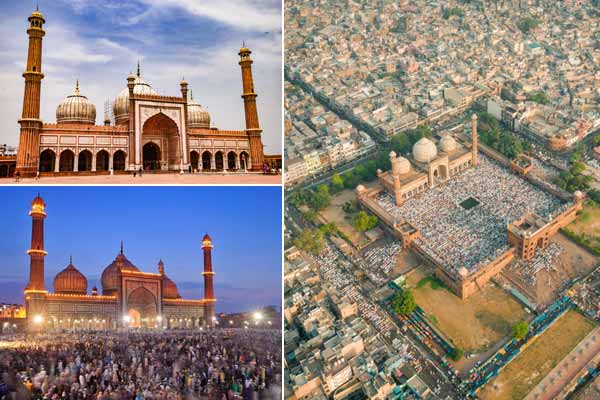
Jama Masjid in Old Delhi is the largest mosque in India built by Mughal Emperor Shah Jahan. The mosque hosts thousands of pilgrims each year on the holy occasion of Eid to offer special Namaz in the morning. With a capacity of twenty-five thousand people in the courtyard, Jama Masjid extends for about 1200 square meters in area with three gateways, four towers and two minarets which are forty meters high. Syed Abdul Ghafoor Shah Bukhari, an Imam from Uzbekistan, inaugurated the mosque. Unfortunately, non-Muslims are not allowed inside the Masjid during Namaz offerings.
Jama Masjid is situated in the older part of Delhi, now called Chandni Chowk and surrounded by beautiful Mughal structures. It took a huge construction cost of one million rupees at the time, five thousand workers and six years (1650-1656) to complete. To reach the entrance one needs to climb 121 steps which are filled with food and bookstalls in the evening. The massive central dome is an outstanding example of Islamic architecture. J Sadaullah Khan who was the Wazir (prime minister) during Shah Jahan’s rule supervised the construction of the mosque. Literally meaning “World Reflecting Mosque.”, the mosque was the last of Shah Jahan’s impressive collection of architectural undertakings, after the Taj Mahal and the Red Fort.
Famous Name – Jama Masjid
Location – Jama Masjid Rd, Chandni Chowk, Delhi
Timing – 8:00am-one hour before sunset, minaret 9:00am-5:30pm
Entry Fee – Tower ₹100, camera & video ₹300
Required Time for Visit – 1 hours
History of Jama Masjid Delhi
This magnificent mosque was built by the Mughal Emperor Shah and constructed between 1650 and 1656. The beautiful architecture of the mosque was designed by the Shah Jahan’s minister Fazil Khan and construction was done under the supervision of Sadullah Khan another minister.
It is constructed by the workers of Arabia, Persia, Europe and India. And, the cost of construction was around 1 million.
On July 23, 1656 the iman established the mosque. Syed Abdul Gafoor Shah Bukhari served as the Shahi Imam of the mosque on the request of Shah Jahan.
When British rule took control over India. The maintenance of the mosque was handled by the Britishers during the starting days. But, after the rebellious Indian revolted against British rule during 1857. The Britishers prohibited any kind of gathering on the mosque premises. Later on, the renovation of the mosque was undertaken twice, firstly by the Nawab of Rampur and then by the Nizams of Hyderabad.
Architecture of Jama Masjid Delhi
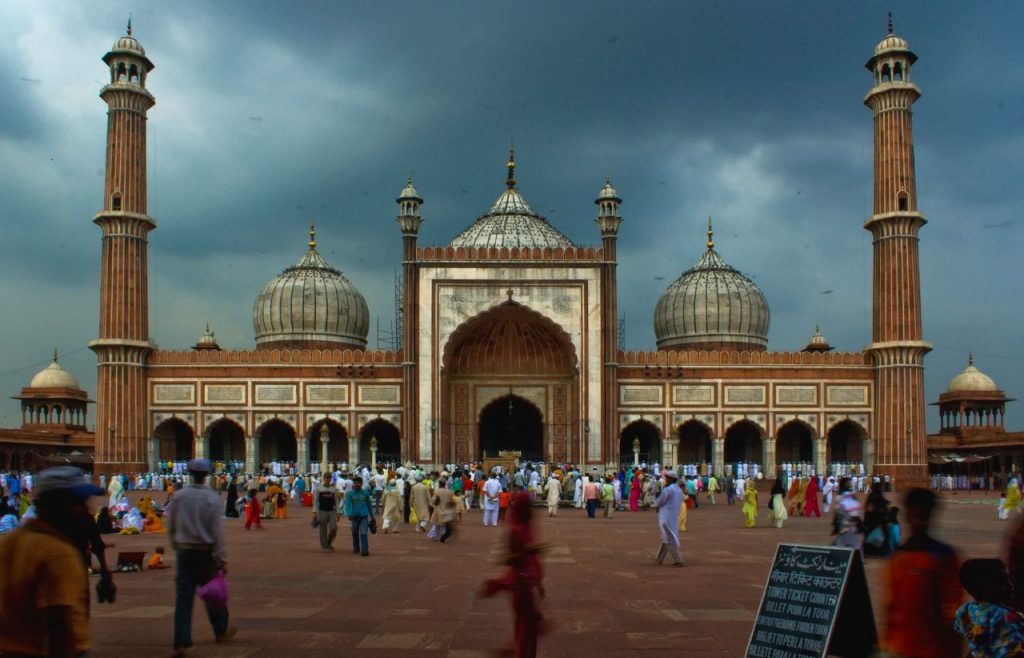
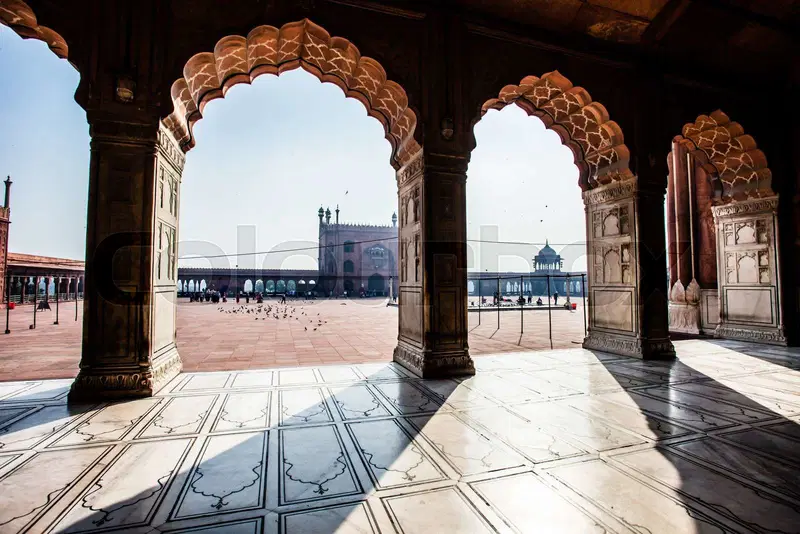
Jama Masjid is an architectural marvel of Delhi. The stunning and fascinating mosque is an outstanding example of Indo-Islamic architecture. The magnificent building is built with marble and red sandstone. This architectural wonder has the capacity to accommodate approximately 25,000 worshippers at one time. Wide red sandstone leads to entryways on East, South and North sides of the mosque. The tower is constructed of five separate storeys; each one is marked by a shielding balcony. Beautiful and captivating calligraphy beautifies its adjacent structures. The first three storeys of the tower are framed with red sandstone; the fourth one is wrapped up with marble, while the fifth storey is constructed of red sandstone again. The grounds of the South Minar are 1076 sq feet and it can easily accommodate 25,000 devotees in a single time.
The main entryway is through the Buland Darwaza, which is 54 metre high. Buland Darwaza or the Gate of Victory was built to celebrate Akbar’s conquest in Gujarat. This imposing entrance is reached by an equally stunning flight of steps. Inside is the colossal courtyard that is took over by white striped and two red sandstone minarets that cap the main prayer hall on the west side facing the holy pilgrimage Mecca. The mosque is covered with elaborated carvings and has verses written from holy Quran.
The main prayer hall of the mosque is made up of marble domes and high cusped arches. It is 28 meters on the west side and stands on 260 pillars that hold up 15 marble domes at several elevations. The marvelous façade has more than eleven arches; all are bedecked with three splendid domes. In comparison with other arches, the central arch is higher and serves as the main entry gate. Devotees use this hall on all week days. The cabinet, which is placed in the north gate of shrine, consists of a collection of Muhammad’s artifacts- the text of Quran written on deerskin, sandals of prophet, footmarks of prophet his red beard hair, all these are placed in a marble block.
Best Time To Visit Jama Masjid, Delhi
Although Jama Masjid can be visited at any time of the year but it appears to be more vibrant during the festival of Eid. Visiting during the months of Ramadan i.e., between May and June, one could find the buzz on the streets of Jama Masjid. Other than this, planning a visit during the winter season i.e., between November and February can help you better explore Jama Masjid as the weather remains cool and pleasant.
How to Reach Jama Masjid Delhi
By Air – Delhi has a good connectivity with all the leading cities of India. Private airlines like City Link, Damania and East West airlines also link Delhi with Mumbai, Calcutta etc.
By Train – The metropolitan city is well connected railhead both on meter guage (Main Delhi) and broad guage (New Delhi) railway line with all the prominent cities in India.
By Road – The capital city is at the meeting point of various national highways and has a good connectivity by regular bus services from ISBT (Inter State Bus Terminal).
Jama Masjid is an ideal pilgrimage destination for Muslims, to pay their reverence. This elegant mosque throng s thousands of worshippers from every part of India and open for people of all caste, religion and creed. Visit this mammoth architectural structure and get impress with Mughal architectural skills.